Runes Protocol
Casey Rodarmor's UTXO-native fungible token metaprotocol for Bitcoin, launched at the April 2024 halving as a deliberately minimal, harm-reducing alternative to BRC-20.
▶ Run interactive simulation animated mechanism with editable parameters
How it works onchain
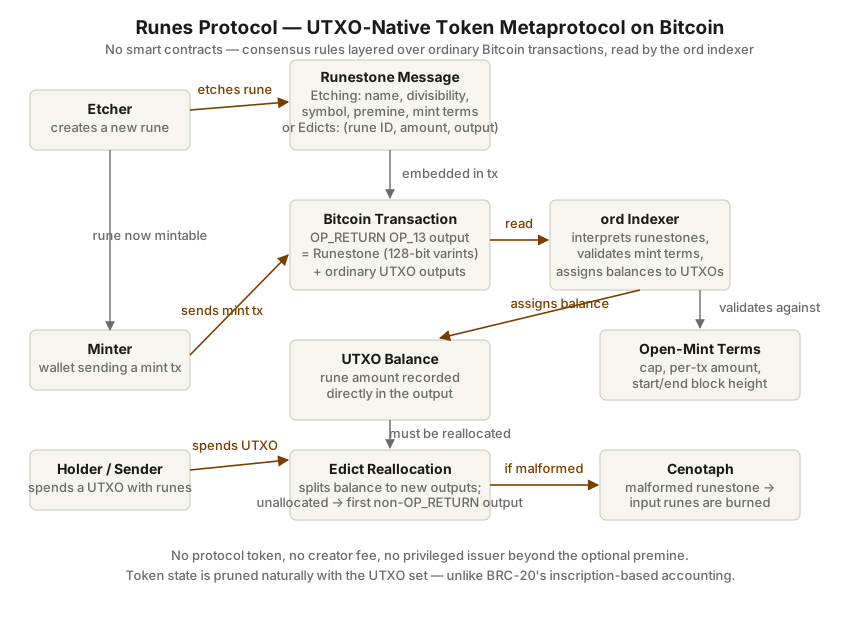 Open full-size diagram
Summary
Runes is a fungible token metaprotocol for Bitcoin created by Casey Rodarmor, the author of Ordinals. He proposed it in a September 25, 2023 blog post with unusual candor — "fungible tokens are 99.9% scams and memes" — arguing that if Bitcoin was going to host token speculation anyway, a well-designed protocol could act as harm reduction against BRC-20, whose JSON-inscription design bloated the UTXO set. Runes activated at block 840,000 on April 20, 2024, deliberately timed to Bitcoin's fourth halving. The launch was a mania: Runes transactions briefly consumed over 90% of Bitcoin network fees, average transaction fees spiked to roughly $128, and daily Runes transactions peaked at ~753,000 on April 23, 2024. Within a year, activity had collapsed to under 2% of Bitcoin fees. The protocol works exactly as specified and remains live and maintained in the ord client, but the economy built on it — almost entirely memecoins — deflated severely.
Design (Mechanism)
Runes is not a smart-contract system; it is a set of consensus rules layered over ordinary Bitcoin transactions, interpreted by indexers running the open-source ord implementation.
- Runestones. Protocol messages are embedded in a single
OP_RETURN OP_13output per transaction, with data pushes decoded as 128-bit varints. Balances live directly in UTXOs — when a UTXO is spent, its rune balance must be reallocated — so token state is pruned naturally with the UTXO set, unlike BRC-20's inscription-based accounting. - Etching. Creating a rune fixes its immutable properties: a 1–26 letter base-26 name (with optional display spacers, e.g. DOG·GO·TO·THE·MOON), divisibility (decimal precision), a display symbol, an optional premine to the etcher, and optional open-mint terms. Name length requirements decrease over time on a schedule, rationing short names.
- Minting. Open mints are governed by on-chain terms: a cap on total mints, a fixed amount per mint transaction, and start/end block heights or offsets. Anyone can mint by sending a qualifying transaction while terms are active — a fair-launch primitive with no central issuer after etching.
- Transfers. Edicts — tuples of (rune ID, amount, output index) — allocate runes among a transaction's outputs. Unallocated runes default to the first non-OP_RETURN output unless a pointer says otherwise.
- Cenotaphs. Malformed runestones burn their input runes rather than being ignored. This is intentional: it makes old clients fail safe and functions as a forward-compatibility/upgrade mechanism, at the cost of punishing user error.
There is no protocol token, no fee to the creator, and no privileged issuer role beyond the optional premine.
Outcome
Technically, Runes did what it promised: a compact, UTXO-native token standard with a far smaller on-chain footprint than BRC-20, live since block 840,000 without a protocol-level failure. Economically, it followed a classic speculative arc. Launch-window mania delivered miners an enormous fee windfall at exactly the moment the halving cut subsidies — Runes briefly represented ~40% of all Bitcoin transactions and 90%+ of fees. Aggregate rune market cap surpassed $1 billion, and the flagship memecoin DOG·GO·TO·THE·MOON (etched from the RSIC airdrop to Runestone holders) peaked around $730M market cap in November 2024 and earned a Coinbase listing. Then activity decayed: fee share fell to ~8% by mid-2024 and under 2% by mid-2025; daily transactions fell from ~150,000 to under 50,000 by late 2024 and to minimal levels after; DOG fell ~87% from peak. Infrastructure work continues (marketplaces, the Alkanes metaprotocol, proposed AMMs), but Runes today is a small fraction of Bitcoin activity. Hence: technically successful, commercially unsuccessful.
Why it worked
- Radical simplicity fitted to Bitcoin. By storing balances in UTXOs and messages in OP_RETURN, Runes needed no consensus change, no new token, and produced far less state bloat than BRC-20 — the harm-reduction goal was genuinely achieved for the activity it captured.
- Credible neutrality of the launch. No premine for the protocol itself, no VC allocation, open etching and capped open mints made it a fair-launch machine, which is precisely what memecoin participants wanted in 2024.
- Perfect narrative timing. Launching at the halving block turned a spec release into a global event and gave miners a fee bonanza when subsidy revenue halved.
- Founder credibility. Rodarmor's Ordinals track record meant instant indexer, wallet, and marketplace support at launch.
Where the design broke
- No use case beyond speculation. Rodarmor said as much upfront. With Bitcoin's minimal scripting, runes had no DeFi, no yield, no utility sink — once memecoin attention rotated to Solana and elsewhere, nothing retained users.
- UX and infrastructure gaps. Trading runes meant PSBT-based marketplaces and indexer trust, far clunkier than an AMM swap on an EVM chain or Solana.
- Fee-market dependence cuts both ways. The mint mechanism monetizes congestion: minting a hot rune is a fee auction, so retail participants were priced out at exactly the moments of peak interest, transferring most value to miners.
- Cenotaph strictness burns user mistakes, a sharp edge for a retail-facing standard.
Lessons
- A token standard's technical elegance does not create demand; Runes fixed BRC-20's externalities but inherited its purely speculative demand curve, and both decayed together.
- Launch timing is a mechanism: tying activation to the halving manufactured coordination and a one-off miner fee subsidy, but a spike engineered by scarcity of block space is self-limiting — congestion pricing throttled the very adoption it monetized.
- "Harm reduction" is a legitimate protocol design goal: shipping a cleaner standard measurably displaced a messier one (BRC-20 activity migrated substantially to Runes), showing incumbent metaprotocols can be outcompeted on footprint.
- Fail-safe strictness (cenotaph burns) protects protocol upgradeability but shifts risk onto the least sophisticated users; standards aimed at retail need forgiving failure modes or wallet-level guardrails.
- Fair-launch open mints with per-transaction fixed amounts turn distribution into a miner-fee auction — an honest but regressive allocation mechanism.
Redesign (EDITORIAL — hypothesis, not fact)
This section is editorial hypothesis, not fact. A redesigned Runes might: (1) replace the per-transaction fixed-amount mint with a batched, height-windowed pro-rata claim (everyone who commits during a window splits the tranche), removing the fee-auction race that priced out retail and enriched snipers; (2) soften cenotaphs into a quarantine state — runes locked and recoverable by the original owner for N blocks before burning — preserving upgrade pressure while forgiving wallet bugs; (3) ship a canonical light-client proof format for indexer state so marketplaces and bridges don't each trust their own indexer, the quiet centralization point of all Bitcoin metaprotocols; and (4) pair the standard at launch with a native trust-minimized swap venue (e.g., PSBT-based batch auctions), since the largest gap versus Solana memecoins was not issuance but liquid, low-friction secondary markets. None of this would fix the underlying demand problem — tokens with no utility sink decay — but it would convert less of the speculative wave into pure fee burn and sniper rents.
Sources
- Runes — Ordinal Theory Handbook (protocol specification) — primary (docs)
- Runes (original proposal) — Casey Rodarmor's blog, Sep 25, 2023 — primary (retrospective)
- ord reference implementation (GitHub) — primary (contract)
- Runes, Casey Rodarmor's Protocol for 'Sh*tcoins' on Bitcoin, Set to Go Live at Halving — CoinDesk (news)
- Bitcoin Runes Launch at the Halving — Decrypt (news)
- Runes Protocol One Year Later: From 90% of Bitcoin Fees to Under 2% — BlockEden.xyz (analysis)
Related experiments
Last verified: 2026-07-27 · Spot an error? Suggest a correction